Marking it’s 40th anniversary today is the 12” single from Duet Emmo, Heart of Hearts (Or So It Seems). In a year of dance floor monster hits, this neglected gem deserves to have far more attention paid to it than has been given since its release. This was the kind of single that you only heard at the absolute hippest underground clubs and it was one that got my ass on the dance floor every time it came on.
Duet Emmo were a one off collaboration between Wire & Dome members, Bruce Gilbert & Graham Lewis, and Mute Records founder, Daniel Miller. The group name is an anagram of the names “Dome” and “Mute”. The trio recorded together a couple of times intermittently throughout 1981/1982, releasing a single and LP in 1983. The single, with the B-side being a dance mix version of Or So It Seems, became a predictive harbinger of future underground trends like atmospheric Drum & Bass and Minimal Techno. A close friend once remarked that it sounded like dance music from the future, and indeed it was!
When I first heard this track shortly after its release, it immediately became one of my favorite club cuts of the era. It was right up there with New Order’s Blue Monday and The The’s Perfect. Looking back on that year, it seems to have been a golden age for underground dance music, with classic after classic finding life on the underground dance floors of the day, often tucked away in dimly lit warehouse spaces in the small hours of countless mind-altered late, late nights.
2023-03-01
DUET EMMO - HEART OF HEARTS (OR SO IT SEEMS) 12” @ 40
2023-02-25
ALICE COOPER - BILLION DOLLAR BABIES @ 50
Marking
its 50th anniversary today is the sixth studio album from the Alice
Cooper band, Billion Dollar Babies, which was released on February 25th,
1973. It was the most popular LP from the band up to that point,
hitting the number one slot in both the US and UK. It was also the
penultimate album by the band before its lead singer, one Vincent
Furnier, would strike out on a solo career, taking the band name with
him.
The first recording sessions for the album took place in
Greenwich, Connecticut, in a mansion called the Galesi Estate. While at
the estate, to achieve certain vocal sounds and echoes, microphones were
run through rooms of various sizes, including a greenhouse. After
beginning recording there in August of 1972, sessions were then held at
Morgan Studios in London, wrapping up by January, 1973. While in
London, Donovan contributed to the album by singing on its title track.
The album was produced by Bob Ezrin, who had been behind the desk for
their albums since Love It To Death in 1971. A quadraphonic mix of the
LP was released on vinyl and reel to reel which featured radically
different mixes, including alternate vocal takes.
The tour to
support the album broke box office records in the US previously set by
The Rolling Stones, with ticket sails pushed by the popularity of the
album and the four hit singles that were taken from it. It represents
the high water mark for the band. The album rocks consistently from end
to end with buckets of memorable hooks littering virtually every song.
2023-02-11
THE THE - PERFECT 12” @ 40
Released
on February 11th, 1983, The The’s single, Perfect, turns 40 years old
today. It’s my favorite song ever released by Matt Johnson and
completely summed up my feelings about the the times, as well as being
the best dance floor fodder in a year with some dead-on all-time
classics in the clubs.
In 1982, Matt Johnson was working closely
with Stevo from Some Bizarre Records and jockeying with a number of
major record labels for a contract. He’d released a debut solo album
under his own name, but was now working on a debut under what would
become his more popular moniker, The The. Johnson and Stevo had gone to
NYC to work with producer Mike Thorne, who had been at the console for
the recent success of Soft Cell. They initially worked on the Uncertain
Smile single, which was released in October of 1982. Work on that song
proceeded very effectively, though there was some issues in terms of
Stevo and his verbal agreement with London Records to release the
singles. He’d reneged on that agreement and, instead, had Johnson sign a
deal with CBS/Epic, despite London Records footing the bill for their
trip to NYC.
At the time of the NYC sessions, the new album was
tentatively titled The Pornography of Despair. After the release of
Uncertain Smile, Johnson and Stevo returned to NYC to record a second
single in advance of the LP. The song they chose to work on was written
for the new album and called, Screw Up Your Feelings, but would become
re-titled as "Perfect". By the time Johnson had returned to NYC, he’d
gone from penniless to having an £80,000 advance from CBS, so he took
advantage of his financial situation to partake in some of the pleasures
of the city, disappearing from the studio to explore the Lower East
Side and take drugs. He and Stevo also took a side trip to Detroit
where Johnson felt he could spend some time really getting into the
headspace he needed to sing the lyrics for his new song, which were
about being “down-and-out”, so he wanted a taste of that lifestyle so he
could bring some authenticity to his performance.
Eventually,
the pair managed to get back into the studio to record, but by this
time, their indulgences were wearing thin on Mike Thorne’s patience and
further disagreements on the song’s production didn’t help. Thorne had
wanted to use his fancy new Synclavier sampler/synth on the track, but
Johnson was insistent on using his “cheap & cheerful” Omnichord
electronic auto-harp instead. With all this conflict, Thorne bailed
from the project after completing the single and Johnson headed back to
London to start from scratch, where he’d record the entirety of what
would become the Soul Mining LP, recording new versions of both
Uncertain Smile and Perfect.
The single for Perfect, especially
it’s 12” extended mix, clocking in at nearly 10 minutes, became an
immediate sensation on the dance floors of the underground and
alternative clubs. I had just started going out to them at exactly the
time this song was released and I remember being immediately enthralled
by it from the very first listen. I have to agree with Matt about that
Omnichord because the bass sound it created is completely essential to
the song’s groove, backed up by that insistent, hypnotic Linn Drum
machine back-beat. And that high-lonesome harmonica on it was played by
none other than New York Dolls front-man, David Johansen. Lyrically,
Matt tapped into the quintessential mood of youthful despondence and
malaise that was essential for the emerging Goth/Industrial dance scene
of the day. His lyrics were so poetic and I had so many days like that
where his words echoed in my head as my post-teen angst over the sadness
of the world loomed in my mind. Yet it was all done with this killer
fucking groove.
Every time this song came on in a club, I HAD to
get on the dance floor, and I was NOT at all into dancing in clubs
before this, being painfully shy and self-conscious. This song, along
with Blue Monday by New Order and All Lined UP from Shriekback, were
irresistible when they came on. Heaven forbid some DJ should play all
three in sequence, which I distinctly remember happening at least once,
necessitating nearly a 30 minute continuous stint of high energy
boogieing until I was a sweaty rag doll. It remains one of my all time
favorite songs, EVER!!!
2023-02-08
THE JAMS - WHO KILLED THE JAMS? @ 35
Released
35 years ago today, on February 8th, 1988, it’s The JAMs (Justified
Ancients of Mu Mu) and their sophomore and final LP, Who Killed the
JAMs?. Not that Jimmy Cauty and Bill Drummond stopped recording, but
they’d go forward predominantly as The KLF after a short stint as The
Timelords for their Doctorin' The Tardis hit single.
After
forming The JAMs to kick off 1987, their debut LP, 1987 (What the Fuck
Is Going On?) literally went up in flames, with all unsold copies
roasted in a bonfire after losing a copyright complaint from ABBA and
the Mechanical-Copyright Protection Society, who ordered all remaining
copies of the album destroyed. After toying with the media by musing
about their second album being a heavy metal cover of Deep Purple songs,
in the end, the real album followed many of the same paths as the first
one, taking samples from popular hits and reworking them into new
pieces with drum machines, synths and vocal choruses added. This time
around, however, the samples were a bit more stealthily handled in order
to avoid legal issues. The cover of the LP shows photos of the burning
of the first album with the front long shot showing Jimmy & Bill
with the car that would become known as Ford Timelord, who would be
credited with composing Doctrorin’ the Tardis. The back cover image is a
closeup of the pile of burning LPs.
Though it was not formally
announced at the time, the music press, based on the album title and
some cryptic comments from the group, assumed this was the swansong for
the JAMs and, in a sense, they were correct, though the group would
issue the album Shag Times to collect together a number of singles from
the era. Upon its release, Who Killed the JAMs? was met with generally
favorable critical responses. Melody Maker declared it to be "divine
nihilism", "an outward show of self-deception, irrationality and
bankruptcy that worries and rejoices itself to death". Sounds thought
the album "a masterpiece of pathos", referring to its "hopeless bravado
in the face of massed corporate opposition", and awarded the maximum
five stars. While the duo were still refining their methodologies and
mythologies, the album definitely contains seeds of what they were
trying to grow, with themes and hooks that would continue to resurface
throughout the KLF's career in the early 1990s. Since its initial
release, however, it has never been reissued except in a very limited
CDr unofficial edition of a couple of hundred copies.
2023-02-07
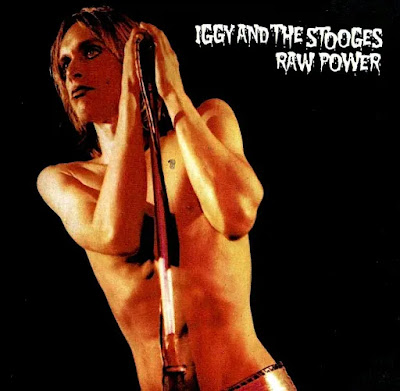
IGGY AND THE STOOGES - RAW POWER @ 50
Released
on February 7th, 1973, Raw Power by Iggy and the Stooges is celebrating
half a century on the shelves today. Despite struggles to get a proper
mix of the album, it continues to stand as one of the most ferocious
proto-punk albums of all time. It’s fierceness and savage intensity have
made it a high water mark for aggressive rock & roll and kept it as
a template for bands who aspire to ascend to its brutal heights.
By
1972, The Stooges were in a shambles. With their first two LPs failing
to garner any serious record sales, the group had fallen into despair
and substance abuse, with Iggy slipping deeper and deeper into his
heroine addiction. The group had functionally ceased to exist and Iggy
had gone off to London to try to dry out under the wing of David Bowie.
Bowie had long been a fan of Iggy’s and was appreciative of the
Stooges’ song writing abilities, far more than most of Pop’s peers of
the time. While in London, Iggy was planning on working with guitarist
James Williamson, who had handled second guitar duties on the last
Stooges tour, and Pop had even negotiated a solo record deal with CBS.
As he and Williamson began to try to get the ball rolling in the UK,
they soon found themselves struggling to put together an acceptable
rhythm section from the local talent available to them. It was at this
point that Williamson suggested recruiting original Stooges, the Asheton
brothers, Ron and Scott, with Ron reluctantly agreeing to move over to
bass so that Williamson could handle all the guitar duties. This
effectively reconstituted the Stooges, albeit in a modified
configuration, but the solo contract with CBS would still necessitate
the band being identified as “Iggy and the Stooges”.
With
Williamson on guitar, the songwriting took on a different feel than the
first two albums, moving away from their funkier grooves into a more
anthemic hard rock kind of sound, though the label insisted on including
two “ballads” on the new album to act as counterpoints on each side of
the record. Recording took place at CBS’ London studio, occurring from
September 10 to October 6, 1972, with Iggy acting as producer. After
this, an initial mix of the album was done by Pop, but the results of
that were rather botched as he mixed most of the instruments into one
stereo channel with the vocals mixed into the other, with little regard
for balance or tone quality. Because of budgetary constraints, they had
little to work with to remedy that situation, but they were able to
hire David Bowie to come in for a day and do a mix of the album. Bowie
recalled:
“(It was) the most absurd situation I encountered … the
first time I worked with Iggy Pop. He wanted me to mix Raw Power, so he
brought the 24-track tape in, and he put it up. He had the band on one
track, lead guitar on another and him on a third. Out of 24 tracks there
were just three tracks that were used. He said 'see what you can do
with this'. I said, 'Jim, there's nothing to mix'. So we just pushed the
vocal up and down a lot. On at least four or five songs that was the
situation.”
However when Morgan Neville's documentary film on Raw
Power was released in 2010, they demonstrated that each individual
instrument was indeed recorded on its own track on the original
multi-track tapes, suggesting that Bowie was either mistaken or working
with a copy that had mixed down the instruments on to the same track,
likely the rejected mix Iggy had done before Bowie’s arrival.
What
Bowie achieved with those limited resources has always been debatable,
with some liking it while most found it murky and lacking in low end.
Thus began the long, sordid story of alternate mixes of the LP. The
original rejected Iggy mix was eventually released as “Rough Power”, and
then, in 1997, Iggy himself created a brand new mix from scratch using
the original multi-track tapes. This version, while addressing some of
the issues with the Bowie mix in terms of lack of bottom end and buried
drums, ended up creating its own issues as Iggy brought back in a lot of
bits Bowie had cut out and pinned the levels on everything to such an
extent that it introduced a layer of digital distortion which unsettled
many purists and fans of the original LP’s mix. Personally, I find the
Iggy mix more listenable overall, though the saturation caused by the
excessive loudness does obliterate any sense of dynamics in the
recordings. Therefore, it remains a flawed album no matter how you
slice it, but a landmark, nonetheless.
Upon its release, the LP
received a lot of critical high praise, but commercially, it was simply
too extreme for any radio play and barely grazed the bottom of the top
200 LP charts in the US. That failure was a final nail in the coffin
for the Stooges and, though Iggy and Williamson did attempt what would
become another aborted project together, subsequently released as Kill
City (1975), Pop would end up returning to Bowie’s care for a far more
successful solo career with his back to back albums, The Idiot and Lust
for Life (1977). The legacy of Raw Power, however, like the previous two
Stooges LPs, would grow over the decades to enshrine all three of these
albums as precursors to, and fundamental foundation stones for, the
punk revolution to come.
2023-02-04
NURSE WITH WOUND - SALT MARIE CELESTE @ 20
Marking
its 20th anniversary this month is Nurse With Wound’s Salt Marie
Celeste, which was released in February of 2003. An early, minimal mix
of the album was issued as “Salt” in 2002, in a split limited edition
release with Current 93 called “Music From the Horse Hospital”. That
version featured an hour long mix of only the swelling, wave like drone
which forms the foundation of the composition. The full version adds
various sounds of groaning and creaking wood, creating an audio
environment meant to evoke the ambiance of a ghost ship - lost,
forgotten and adrift in the void of an endless ocean.
The
reference in the title is to the infamous Marie Celeste brigantine ship
found adrift and deserted in the Atlantic Ocean off the Azores Islands
on December 4, 1872. The reasons for her fate have never been
resolved...
“At the salvage hearings in Gibraltar following her
recovery, the court's officers considered various possibilities of foul
play, including mutiny by Mary Celeste's crew, piracy by the Dei Gratia
crew or others, and conspiracy to carry out insurance or salvage fraud.
No convincing evidence supported these theories.”
- Wikipedia
In
2022, to mark the 20th anniversary of its original recording by Steven
Stapleton and Colin Potter, a double CD edition was released containing
both variations of the recording.
23 SKIDOO - THE CULLING IS COMING @ 40
Released
on February 4th, 1983, the sophomore LP from 23 Skidoo, The Culling Is
Coming, is marking its 40th anniversary today. It’s an album of deeply
ritualistic significance and one of the strangest releases in the
group’s catalogue.
Side one of the album, A Summer Rite, was
recorded live at 11.23 AM on July 17, 1982, during the very first WOMAD
(World of Music, Arts and Dance) festival, organized by Peter Gabriel in
Shepton Mallet, UK. The performance featured David Tibet of Current 93
on Tibetan Trumpet. The original side B material, A Winter Ritual, was
recorded at Dartington Music College, on October 23, 1982. The
original pressing of the LP has a lock groove between the 4th and 5th
tracks on side A, with "Command as fuck" inscribed in the vinyl. The A
side duration is therefore listed as “infinite” (∞). The B-side has a
precise duration of 23 minutes. The later CD edition swapped the order
of the LP sides and added a third section, An Autumn Journey, to fill
out the additional CD capacity.
The music on the album is
heavily influenced by eastern Gamelan percussion & gongs, combining
that sound with more experimental Industrial ambience and sonic
manipulations. With that influence, it is the group’s least rhythmic
release, focusing as it does on ritual ambiences and occult themes.


